On this page
- The Color Transition: The Single Best Check
- The UV Light Test: A Genuinely Unique Check
- Color Tone Accuracy
- Engraving Depth: A Test You Can Feel
- The Bezel Click Count
- The Jumping-Hour GMT Function
- Confirming the Reference
- What These Checks Won't Guarantee
- Why the Pepsi Specifically Gets Targeted
- FAQ
- Conclusion
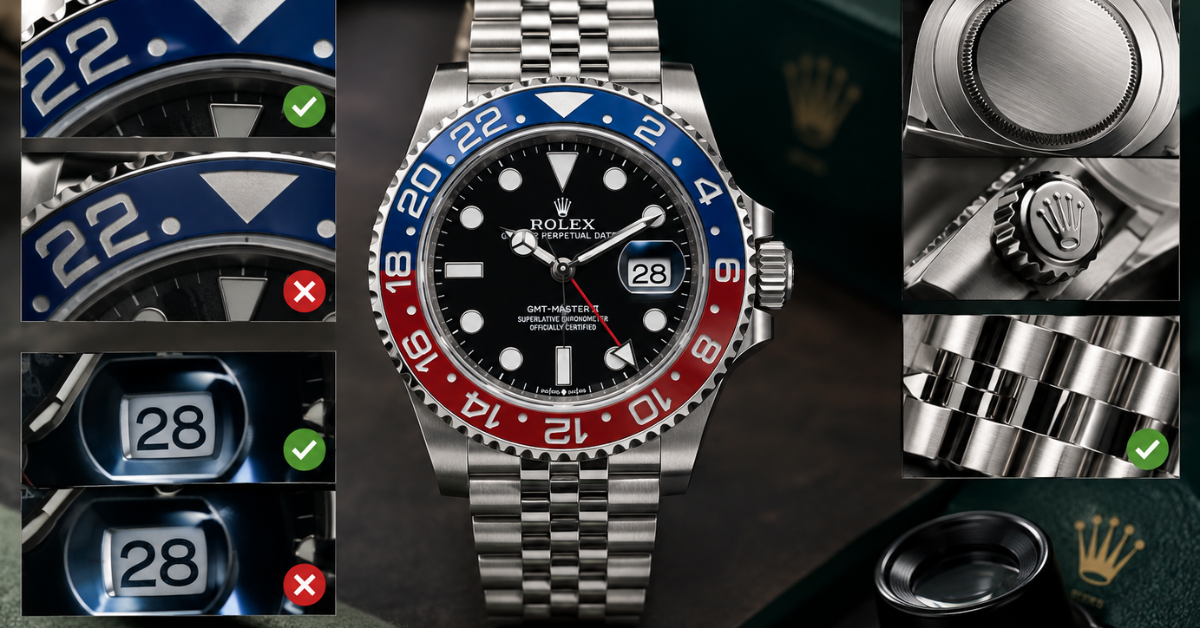
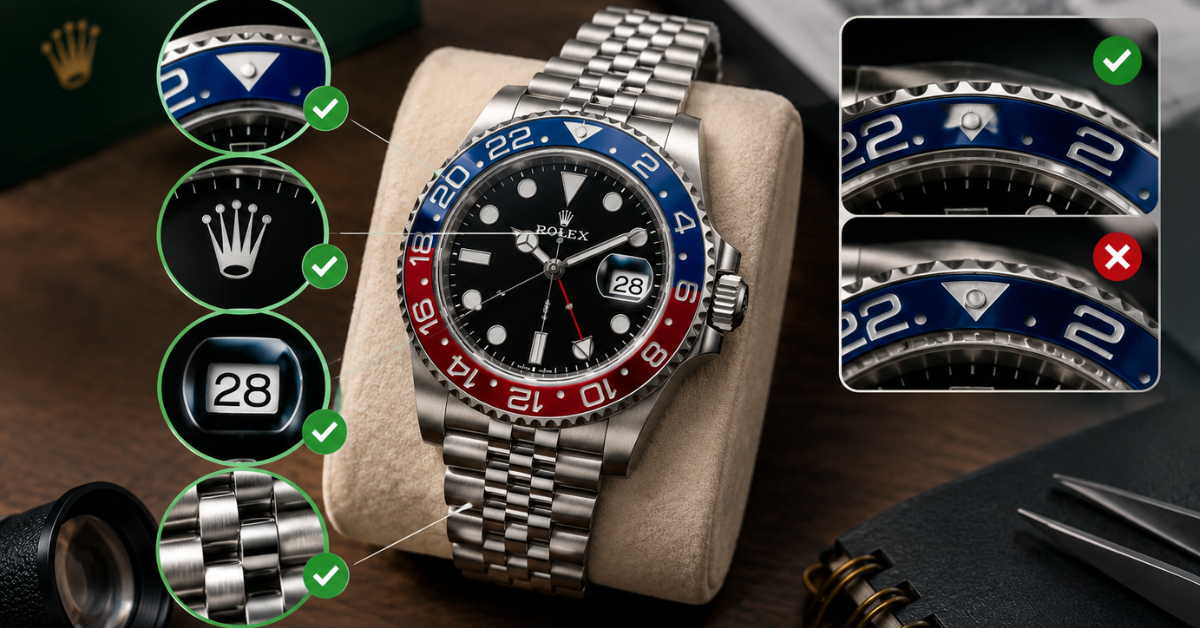
The single most reliable check on a Rolex GMT-Master II Pepsi is the color transition at the 6 and 18 o'clock positions on the bezel — genuine Cerachrom ceramic shows a perfectly sharp, straight boundary between red and blue, cut cleanly enough to look machined even under magnification, while counterfeits almost always show a soft, blurred, or bleeding transition. A genuine bezel also glows entirely red under UV light, a byproduct of the high-temperature sintering process used to create the two-tone ceramic, and its numerals are molded into the material and platinum-filled rather than printed on the surface. The bezel completes a full rotation in 24 firm, precise clicks.
The Pepsi's red-and-blue bezel is one of the most recognizable design details in watchmaking, which makes it one of the most heavily counterfeited too. Rolex's proprietary process for fusing two colors into a single ceramic bezel piece remains genuinely difficult to replicate, and that difficulty is exactly what makes the bezel the most productive place to focus your attention. This covers the checks that actually separate a genuine Pepsi from a convincing fake. For the fuller history behind this bezel and its siblings, our GMT-Master II bezel guide covers Pepsi, Batman, and Root Beer's real origins in depth — this piece focuses specifically on telling genuine from fake.
The Color Transition: The Single Best Check
Look closely at where red meets blue, at the 6 and 18 o'clock positions on the bezel. On a genuine two-tone Cerachrom insert, that boundary is dead straight and razor-sharp, even under a loupe — Rolex forms both colors within a single ceramic piece through a patented manufacturing process, producing a transition clean enough to look machine-cut. Counterfeits consistently fail to replicate this precision, showing a softer, blurred, or gradient transition where the colors bleed into each other rather than meeting cleanly. This single detail is widely regarded as the most reliable authentication point available on the entire watch, precisely because Rolex's two-color ceramic fusion process is so difficult to reproduce cheaply.
The UV Light Test: A Genuinely Unique Check
This is a less commonly known test, and it's worth learning because it's difficult for a counterfeit to pass by accident. Genuine Rolex Pepsi bezels are sintered at roughly 1,600 degrees Celsius for over 24 hours during manufacturing — an intense, prolonged heat process that leaves a red undertone beneath the visible blue portion of the ceramic. Shine a UV light on an authentic bezel, and the entire insert glows red, revealing that underlying tone in a way that's genuinely striking to see. Replicating this specific optical property requires replicating Rolex's actual sintering process, not just matching the visible surface color — which is exactly why it's such a useful, hard-to-fake test.
Color Tone Accuracy
Beyond the transition itself, the actual shades matter. A genuine Pepsi bezel's blue should read as a deep navy, not a bright or electric blue, and the red should be a rich, deep cherry tone rather than anything orange-tinted or overly vivid. Fakes frequently miss this balance in one direction or the other — too bright, too flat, or simply the wrong hue entirely when compared side by side against verified reference photography.
Engraving Depth: A Test You Can Feel
Run a fingernail lightly across the bezel's numerals and graduations. On a genuine bezel, these markings are molded directly into the ceramic during manufacturing and filled with platinum via a PVD process on steel models — meaning you can actually feel a slight recess where the numeral sits below the surrounding ceramic surface. Counterfeits frequently take a shortcut here, printing or applying numerals on top of the surface rather than molding them into the material. Printed markings that sit flush or raised rather than recessed are a legitimate red flag worth pursuing further.
The Bezel Click Count
Rotate the bezel through a full turn and count the clicks. A genuine GMT-Master II bezel completes a full rotation in 24 firm, evenly spaced clicks — worth noting explicitly, since this differs from the 120-click count that applies to Submariner bezels, covered in our 60-second Submariner fake test. The GMT-Master II's 24-click count corresponds to its 24-hour bezel markings, and each click should feel precise and consistent. Fakes commonly feel gritty, loose, or uneven through the rotation — a mechanism that's genuinely difficult to replicate cheaply, similar to what we've documented on other Rolex sports references.
The Jumping-Hour GMT Function
This is a functional test worth running alongside the visual checks. On a genuine GMT-Master II, adjusting the local hour via the crown's middle position makes the hour hand jump cleanly to the next hour without disturbing the running minutes or seconds — the independently adjustable mechanism that makes this watch a genuine travel tool rather than just a watch with an extra hand. Our guide to setting a Rolex date covers exactly how this crown mechanism should behave. On most counterfeits, the hour hand moves together with the minute hand rather than jumping independently — a mechanical shortcut that's often the clearest giveaway once you know to test for it.
Confirming the Reference
The current steel Pepsi carries reference 126710BLRO, running Rolex's Caliber 3285 in a 40mm case. If you're evaluating a watch claiming to be this reference, our reference numbers decoded guide helps you verify that the engraved number, case details, and configuration all actually correspond to a real Rolex catalog entry rather than a plausible-sounding string.
What These Checks Won't Guarantee
Worth being honest about the limits, consistent with how authentication should always be approached: the highest-quality counterfeits have gotten close enough on individual details that no single check, or even this full combination, provides absolute certainty on its own. These checks together catch the significant majority of Pepsi fakes in circulation, particularly since replicating the two-color ceramic fusion process and its UV sintering signature is genuinely expensive to do well. For any high-value purchase, professional authentication from an authorized dealer or an experienced independent watchmaker remains the only way to be fully certain. Our general field guide to spotting a fake Rolex covers additional checks that apply across Rolex's wider catalog, useful alongside the Pepsi-specific details here.
Why the Pepsi Specifically Gets Targeted
The Pepsi's combination of instant visual recognition and genuine secondary-market premium makes it a natural counterfeit target — multi-year waitlists at authorized dealers have historically pushed real transaction prices well above retail, which is exactly the gap counterfeiters try to exploit with a convincing-looking copy sold at a discount.
FAQ
What's the fastest way to check if a Rolex Pepsi bezel is genuine? Look at the color transition at the 6 and 18 o'clock positions — genuine ceramic shows a perfectly sharp, straight boundary between red and blue, while fakes typically show a soft or blurred transition.
Does a genuine Rolex Pepsi bezel actually glow under UV light? Yes — the ceramic's high-temperature sintering process leaves a red undertone beneath the blue portion, causing the entire bezel to glow red under UV light, a property that's difficult for counterfeits to replicate.
How many clicks does the GMT-Master II bezel have? 24 clicks per full rotation, corresponding to its 24-hour markings — a different count than the Submariner's 120-click bezel.
Can I feel the difference between genuine and fake bezel engraving? Yes — genuine numerals are molded into the ceramic and filled with platinum, creating a slight recess you can feel with a fingernail, while many fakes print numerals on the surface instead.
Is the jumping-hour function a reliable way to spot a fake GMT-Master II? Yes — on a genuine watch, adjusting the local hour makes the hand jump independently without disturbing the minutes, while most fakes move the hour and minute hands together.
Conclusion
The Pepsi bezel is both the watch's most recognizable feature and its most reliable authentication point, precisely because Rolex's two-color ceramic process is so difficult to fake convincingly. Run through the color transition, the UV test, the engraving depth, and the bezel action together, and you'll catch the overwhelming majority of counterfeits before you ever need to involve a professional.
Editor-in-Chief
Editorial Team
The RolexWatches.blog editorial desk — independent watch journalism, reviews and buying advice.